
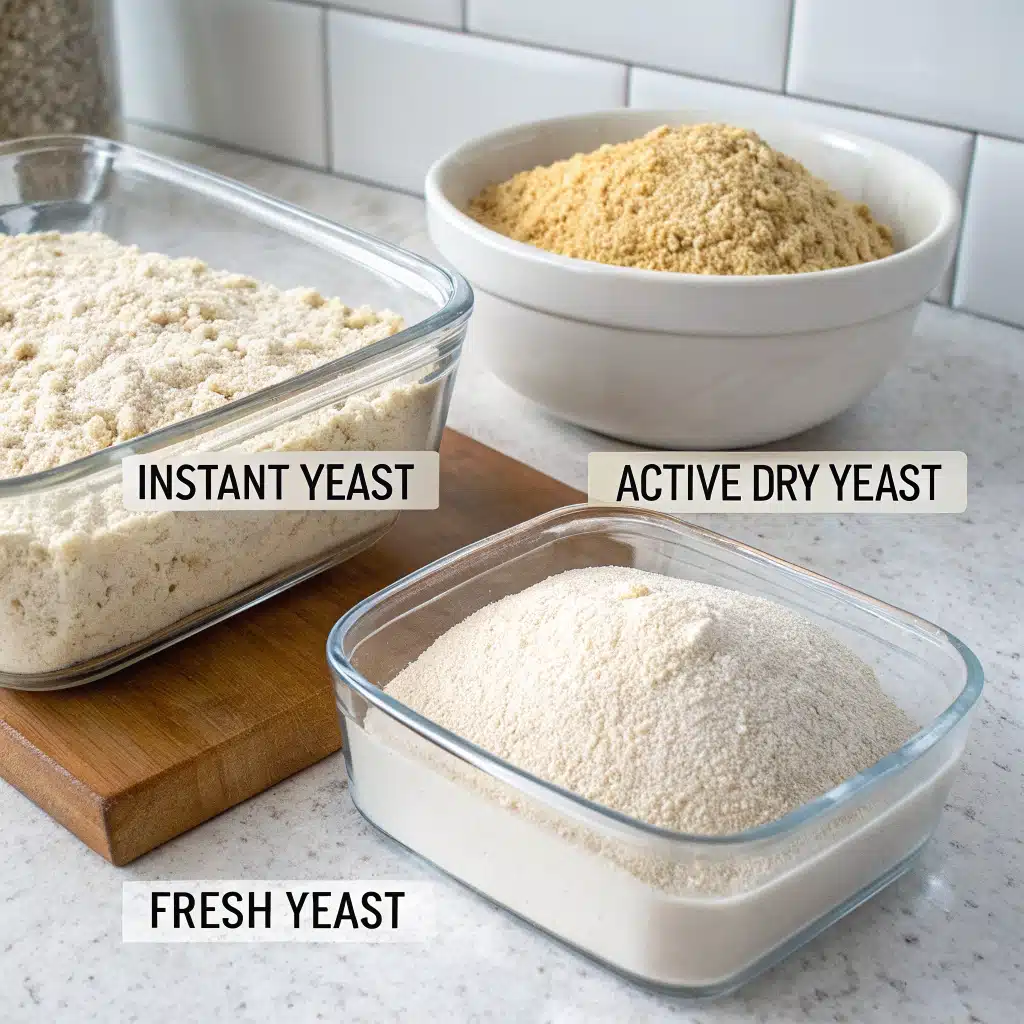
Best Yeast Types for Bread: Instant vs. Active vs. Fresh
The humble yeast cell is the engine of nearly every loaf of bread, responsible for the airy texture, complex flavor, and satisfying rise that defines great baking. For the home baker, navigating the world of yeast—from dried granules to soft blocks—can be confusing. Choosing the wrong type or using it incorrectly can mean the difference between a beautifully risen boule and a dense, disappointing brick.
This guide, written for beginner to intermediate bakers, demystifies the three primary types of yeast available in the home kitchen: Instant Dry Yeast, Active Dry Yeast, and Fresh Yeast. We will explore how each functions, the practical differences in their use, and, most importantly, how to ensure you are always selecting the best yeast for your specific baking project.
Understanding the Core Concept: How Yeast Works
Yeast is a single-celled fungus (Saccharomyces cerevisiae) that performs a vital biological process called fermentation. When yeast is introduced to warm water and a food source (sugar or starch, which it derives from the flour), it wakes up and begins metabolizing the carbohydrates.
The byproducts of this metabolism are ethanol (alcohol) and, crucially for bread, carbon dioxide gas. This gas gets trapped within the matrix of the developing gluten structure in the dough, causing the dough to inflate or “rise.” The longer the fermentation, the more complex the flavor profile becomes, as the yeast produces various organic acids.
The Difference Between Yeast Types is Preparation
While all three common types of baking yeast are the same species, their primary difference lies in how they are processed and prepared for storage, which dictates how quickly they become active in your dough.
Key Factors and Principles Governing Yeast Selection

Selecting the right yeast is about understanding two key factors: hydration tolerance and concentration.
Hydration Tolerance and Protection
Both Active Dry Yeast (ADY) and Instant Dry Yeast (IDY) are dormant, dehydrated versions of the fungus. ADY granules are larger and encased in a thicker layer of dead yeast cells, which protects the live cells but requires a gentle rehydration process (proofing) before use. IDY granules are smaller and more porous, allowing them to absorb moisture rapidly, hence the “instant” designation. Fresh yeast is already hydrated and metabolically active.
The Golden Ratio: Conversion Rates
Because of these differences in processing and moisture content, the yeast types have different concentrations of active cells. Knowing the standard conversion rates is essential when substituting one type for another in a recipe:
* **1 part Fresh Yeast**
* **= 0.5 parts Active Dry Yeast**
* **= 0.33 parts Instant Dry Yeast**
For example, if a recipe calls for 3 grams of IDY, you would need approximately 9 grams of Fresh Yeast or 4.5 grams of ADY to achieve the same rising power.
Image Prompt 1: A realistic photo showing three small, clearly labeled bowls side-by-side on a wooden countertop. The first bowl contains fine, light-brown Instant Dry Yeast granules. The second bowl contains slightly larger, darker Active Dry Yeast granules. The third contains a small, soft, beige cube of Fresh Yeast. Natural kitchen lighting.
Practical Methods and Techniques for Each Yeast Type
Understanding the unique requirements of each yeast type will lead to more consistent baking results.
1. Instant Dry Yeast (IDY)
IDY is the most popular choice for modern home baking due to its convenience.
**How to Use:** IDY can be mixed directly into the dry ingredients (flour and salt) without prior hydration. The moisture from the dough recipe will activate it. This is ideal for stand mixers and quick doughs.
**Best For:** Almost all bread types, especially high-hydration doughs (like focaccia or ciabatta) and recipes requiring a single, fast rise.
2. Active Dry Yeast (ADY)
ADY requires an extra step but offers the baker a vital quality control check.
**How to Use (Proofing):** Proofing ADY ensures it is alive before you commit it to the rest of your ingredients.
1. **Temperature:** Use water between 105°F and 115°F (40°C to 46°C). Water that is too cold won’t wake the yeast; water that is too hot will kill it.
2. **Dissolve:** Dissolve the measured ADY and a pinch of sugar (or flour) in the warm water.
3. **Wait:** After 5–10 minutes, the mixture should be frothy and bubbly, indicating the yeast is active. If there are no bubbles, the yeast is dead and should be discarded.
**Best For:** Recipes that benefit from slightly slower initial activity, allowing more time for flavor development, or when using older yeast that needs a viability test.
3. Fresh Yeast (Compressed Yeast)
Fresh yeast (also called cake yeast or compressed yeast) is the traditional choice favored by professional bakers for its superior flavor contribution and consistency.
**How to Use:** Fresh yeast is highly perishable and must be kept refrigerated. It should be crumbled and dissolved directly into a small amount of the recipe’s liquid (usually lukewarm water or milk) before being added to the dry ingredients. No proofing is strictly necessary if the yeast is fresh, but ensuring it dissolves completely is key.
**Best For:** Enriched doughs (like brioche or challah), sweet doughs, and recipes where a subtle, clean yeast flavor is paramount.
Image Prompt 2: A close-up, educational shot of a glass measuring cup containing lukewarm water and Active Dry Yeast. The surface of the water is starting to show a thick, creamy layer of foam and small bubbles, indicating successful proofing and active yeast. Soft, diffused lighting.
Common Mistakes and How to Avoid Them
Even experienced bakers stumble on yeast issues. Here are the most common pitfalls:
Mistake 1: Using Water That Is Too Hot
The most common mistake is using scalding water, which instantly kills the yeast cells. Yeast is a living organism and is sensitive to heat.
**The Fix:** Always measure your liquid temperature with a thermometer. Aim for the sweet spot: 105°F–115°F (40°C–46°C) for proofing ADY, and slightly cooler (around 95°F/35°C) if incorporating fresh yeast into the dough directly.
Mistake 2: Mixing Salt Directly with Yeast
Salt is a fermentation inhibitor; it controls the yeast’s activity, which is good in moderation. However, placing concentrated salt directly onto fresh or dry yeast for extended periods can draw the moisture out of the cells (osmosis) and kill them.
**The Fix:** When using IDY, mix the salt into the flour first, creating a barrier between the salt and the yeast until the liquid is added. If proofing ADY, add the salt *after* the yeast is fully incorporated into the dough.
Mistake 3: Storing Yeast Improperly
Dry yeast (ADY and IDY) loses viability rapidly when exposed to air, moisture, and heat. Fresh yeast spoils quickly even when refrigerated.
**The Fix:** Store dry yeast in an airtight container in the freezer. It will remain viable for a year or more. Store fresh yeast in the refrigerator and use it within one to two weeks of purchase.
Tips, Best Practices, and Variations

Optimizing yeast performance goes beyond just selection; it involves controlling the fermentation environment.
Temperature Control and Fermentation Speed
The ambient temperature of your kitchen dramatically affects yeast activity.
* **Warm Environments (75°F–85°F / 24°C–29°C):** Yeast ferments quickly, leading to a fast rise but potentially less complex flavor. Use this for quick-bake recipes.
* **Cold Environments (40°F / 4°C):** Cold fermentation (or cold proofing) slows the yeast almost to a halt. This extended, slow process produces superior flavor compounds (organic acids) and improves the dough’s structure. This technique is highly recommended for artisan breads.
Using Less Yeast for Better Flavor
A common professional baking secret is to reduce the amount of yeast called for in a recipe and compensate by extending the bulk fermentation time. While IDY is designed for speed, using half the amount and allowing the dough to rise for two hours instead of one will yield a loaf with significantly greater depth of flavor. This practice works well with all yeast types.
Image Prompt 3: A high-angle, educational photo of a stainless steel bowl containing rising bread dough (a lean white dough). The dough has doubled in size and shows clear signs of successful fermentation, with small bubbles visible just beneath the surface. A digital thermometer is positioned nearby, reading the ambient temperature.
FAQ
Can I substitute Active Dry Yeast for Instant Dry Yeast?
Yes, but you must increase the quantity by about 25% to 33% (use 1.25 to 1.33 times the amount of ADY as IDY) and remember to proof the ADY first.
Does the type of yeast affect the bread’s flavor?
Yes. While the flavor differences are subtle, Fresh Yeast is generally credited with providing the cleanest, most desirable yeast flavor, especially in sweet or enriched doughs. Fast-rising Instant Dry Yeast can sometimes impart a slightly more noticeable ‘yeasty’ aroma if used in large quantities.
How do I know if my dry yeast is still good?
The only reliable way to check dry yeast (especially ADY) is to proof it. Dissolve a small amount in warm water (110°F) with a pinch of sugar. If it doesn’t foam vigorously within 10 minutes, it is dead and should be discarded.
Conclusion
Mastering the art of bread baking begins with understanding the engine: yeast. Whether you prefer the convenience of Instant Dry Yeast for its speed, the reliability of Active Dry Yeast for its proofing check, or the traditional flavor of Fresh Yeast, knowing the conversion ratios and temperature requirements is key to consistent success. Start by choosing the yeast best suited to your recipe’s timeframe, always check your water temperature, and never fear reducing the yeast quantity to unlock deeper, more complex flavors in your next loaf.