
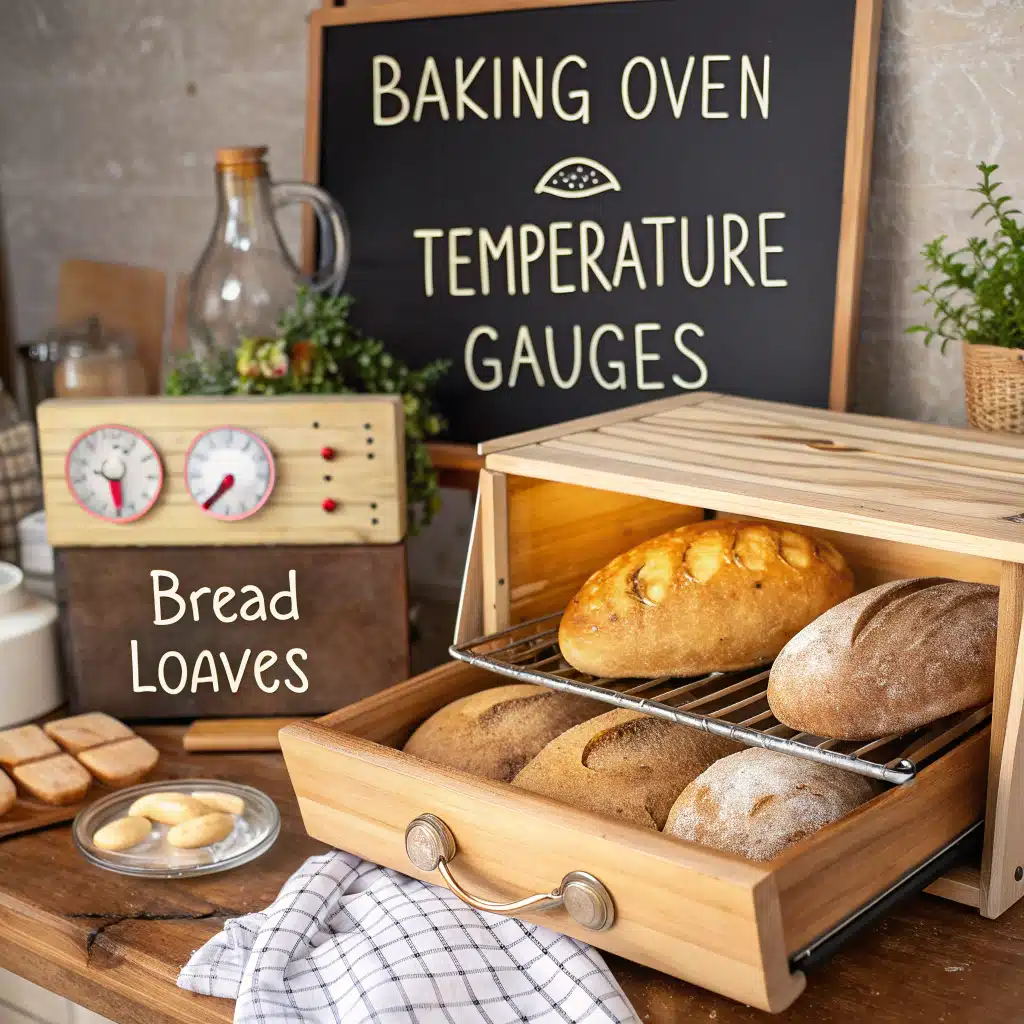
Bread Baking Temperatures: What They Mean and How They Affect Results
Baking bread is often described as a delicate balance of ingredients, time, and technique. However, the final, most critical variable—the one that dictates whether your loaf achieves glorious height and a perfect crust—is temperature.
For many home bakers, oven temperature is treated as a simple dial setting. In reality, successful bread baking requires understanding temperature not as a single number, but as a dynamic process that must change throughout the bake to achieve optimal results. Mastering oven temperature is the key to unlocking superior oven spring, developing a deep, complex crust flavor, and ensuring a fully cooked, tender crumb.
This guide delves into the science behind oven heat, explaining exactly what happens to your dough at various stages and providing practical methods to control the final outcome of every loaf you bake.
Understanding the Core Concept: Heat Transfer and the Bread Structure
When your dough enters the oven, it undergoes rapid, transformative changes that set the final structure of the loaf. These changes are entirely governed by the transfer of heat from the oven environment into the dough mass.
The baking process can be broken down into two critical temperature-dependent phases: the initial expansion (Oven Spring) and the subsequent setting (Crust and Crumb Development).
Phase 1: Maximizing Oven Spring
Oven spring is the rapid expansion of the dough mass during the first 10 to 15 minutes of baking. This requires intense, immediate heat.
When the dough hits a hot environment, three things happen almost simultaneously, driving the loaf upward:
1. **Gas Expansion:** The carbon dioxide trapped within the gluten matrix expands rapidly due to the heat.
2. **Yeast and Enzyme Activity:** Yeast activity spikes dramatically (up to about 140°F / 60°C) before the yeast is killed off. This final burst of activity produces a small amount of gas.
3. **Steam Production:** Water inside the dough turns to steam, which creates immense internal pressure, pushing the dough outward and upward against the still-soft gluten structure.
To maximize this spring, the dough needs the highest possible initial heat and thermal mass (like a baking stone or Dutch oven) to ensure the heat penetrates quickly before the gluten structure sets.
Phase 2: Setting the Crumb and Developing the Crust
Once the dough reaches approximately 140°F (60°C), the gluten structure begins to solidify. Now, the goal shifts to cooking the interior and developing the exterior.
* **Starch Gelatinization:** Starch granules absorb moisture and swell, eventually gelatinizing (setting) between 180°F and 210°F (82°C and 99°C). This process forms the stable, airy crumb structure.
* **Maillard Reaction and Caramelization:** These chemical reactions are responsible for the rich brown color and deep, complex flavor of the crust. They typically begin around 300°F (150°C) and intensify rapidly at higher temperatures.
If the internal temperature doesn’t reach 200–210°F (93–99°C), the crumb will remain gummy and sticky. If the external temperature is too high for too long, the crust will burn before the interior is fully cooked.
Image Prompt 1: A realistic photo showing two cross-sections of rustic sourdough loaves side-by-side: one with a beautiful, airy open crumb, deep golden crust, and large holes (labeled ‘Optimal Temperature’) and one with a dense, tight crumb, pale crust, and heavy bottom (labeled ‘Low Initial Temperature’).
Key Factors and Principles Influenced by Oven Temperature

The temperature you choose, and how you manage it, directly controls several critical outcomes:
The Role of Thermal Mass
In professional ovens, thick steel or stone floors retain massive amounts of heat. In a home oven, which loses heat quickly when the door opens, you must replicate this thermal mass. A baking stone, baking steel, or—most commonly—a heavy Dutch oven acts as a heat reservoir.
When cold dough hits a highly preheated thermal mass (e.g., a 500°F Dutch oven), the heat transfer is immediate and intense, driving maximum oven spring. Baking without adequate thermal mass results in loaves that spread out rather than spring up.
Steam Management and Crust Thickness
Steam plays an essential role in the initial stages of baking and is intrinsically linked to temperature. Steam slows down the rate at which the crust forms a hard skin.
In a dry, high-heat environment, the crust sets quickly, restricting the loaf’s ability to spring. When steam is present, the surface of the dough remains moist and pliable, allowing the loaf to expand for the full 10–15 minutes of oven spring.
Once oven spring is complete, the steam must be removed (or the lid of the Dutch oven must be taken off) to allow the crust temperature to rise above 300°F (150°C), enabling the necessary Maillard reactions for browning and flavor development.
Loaf Density and Baking Time
The size and density of your loaf dictate the overall baking time and temperature schedule.
* **Lean Doughs (Sourdough, Baguettes):** These typically benefit from very high initial temperatures (475°F to 500°F / 245°C to 260°C) because they are mostly water and flour, requiring intense heat to set the structure and achieve a dark crust.
* **Enriched Doughs (Brioche, Challah):** Doughs containing sugar, milk, butter, and eggs brown much faster due to the presence of fats and sugars. These require significantly lower oven temperatures (350°F to 375°F / 175°C to 190°C) to prevent the crust from burning before the dense interior cooks through.
Practical Methods for Temperature Management: The Step-Down Technique
The most effective way to manage temperature for lean, rustic loaves is the “step-down” method, which maximizes both spring and even cooking.
Step 1: Preheat Thoroughly (45–60 Minutes)
Set your oven to the highest desired initial temperature, usually 475°F to 500°F (245°C to 260°C). If using a baking stone or Dutch oven, it is crucial that the thermal mass reaches this temperature. Preheating for less than 45 minutes often means the air temperature is correct, but the mass needed for heat transfer is still cold.
Step 2: The High-Heat Spring (15–20 Minutes)
Place the dough into the preheated oven or Dutch oven. If you are using a Dutch oven, place the lid on immediately to trap the dough’s internal moisture, creating instant steam. If baking on a stone, introduce steam using a pan of hot water or ice cubes on a lower rack.
Maintain the high temperature for the duration of the oven spring (15 to 20 minutes). This sets the volume of the loaf.
Image Prompt 2: A realistic, well-lit photo of a baker wearing thick oven mitts carefully lifting the lid off a smoking hot Dutch oven inside a home oven, revealing a loaf of bread that has sprung significantly but is still pale in color.
Step 3: Dropping the Temperature and Finishing the Crumb
After the oven spring period, the gluten structure is set. Now, we must reduce the heat to prevent the crust from darkening too fast while the interior finishes cooking.
Reduce the oven temperature to 425°F to 450°F (220°C to 230°C). If using a Dutch oven, remove the lid. If using steam, remove the steam source.
Continue baking for another 20 to 35 minutes, or until the crust reaches your desired color (deep golden brown to mahogany).
Common Mistakes and How to Avoid Them
Temperature-related errors are common, especially for new bakers.
Mistake 1: Relying on the Oven Dial
Most home oven thermostats are inaccurate, sometimes by as much as 50°F (10°C) or more. Furthermore, the dial only measures the air temperature, not the internal temperature of your thermal mass.
**Solution:** Always use a dedicated, inexpensive oven thermometer placed near your baking surface. Calibrate your oven if necessary, and ensure your thermal mass has reached the target temperature before loading the dough.
Mistake 2: Baking Too Hot for Too Long
A loaf baked at 500°F (260°C) for the entire duration will inevitably result in a crust that is black or burned, while the center remains undercooked and gummy.
**Solution:** Always implement the step-down technique. The high heat is a sprint, not a marathon. Once the loaf has sprung, lower the temperature to allow for slow, even cooking of the interior.
Mistake 3: Pulling the Loaf Too Early
The loaf may look beautiful and dark brown on the outside, but appearance alone is not enough. If the internal temperature is too low, the crumb will be dense and overly moist.
**Solution:** Use an instant-read thermometer to check the internal temperature before removing the loaf. For lean bread, the internal temperature should register between 200°F and 210°F (93°C and 99°C). For enriched doughs, 190°F to 200°F (88°C to 93°C) is often sufficient.
Advanced Tips, Best Practices, and Variations

For intermediate bakers seeking more control, these practices help refine temperature management:
Calibrating for Convection
If your oven offers a convection setting (fan forced heat), use it. Convection circulates air, ensuring more even browning and faster heat transfer. However, convection tends to dry the crust out faster and increase browning.
**Best Practice:** When using convection, reduce the standard recipe temperature by 25°F (15°C) and reduce the total baking time slightly.
The Double-Pan Method for Burning Bottoms
If your oven’s heating element is close to the bottom rack, you may experience a burned or overly dark bottom crust. This is especially common when baking directly on a stone or steel.
**Best Practice:** Place a second, empty baking sheet on the rack beneath your primary baking surface. This acts as a heat shield, insulating the bottom of the loaf from the direct radiant heat of the lower element.
Image Prompt 3: A close-up, realistic photo of a digital instant-read thermometer inserted into the side of a cooling, golden-brown loaf of rustic bread, showing a clear reading of 208°F.
FAQ
What is the absolute minimum internal temperature for bread to be considered done?
The minimum safe internal temperature for the starch to fully gelatinize and the crumb to set is generally 200°F (93°C). Pulling the loaf below this temperature risks a gummy texture.
Does the type of flour affect the baking temperature?
Yes. Whole grain flours (like whole wheat or rye) retain more moisture and are denser than white flours. They often benefit from a slightly lower finishing temperature (400°F–425°F / 200°C–220°C) to ensure the heat reaches the center without burning the high-fiber crust.
Why do my baguettes bake at a lower temperature than my sourdough boules?
Baguettes have a very high surface area-to-volume ratio. They cook much faster and require a cooler temperature (often 450°F / 230°C, dropped to 400°F / 200°C) for a shorter time (20–25 minutes total) to achieve a crisp crust without over-browning. Larger boules need more time for heat penetration.
Conclusion
Temperature is not just the heat setting on your oven; it is the ultimate tool for shaping the final structure and flavor of your bread. By understanding the critical phases of baking—maximizing oven spring with high, initial heat and securing the crumb with lower, sustained heat—you move