
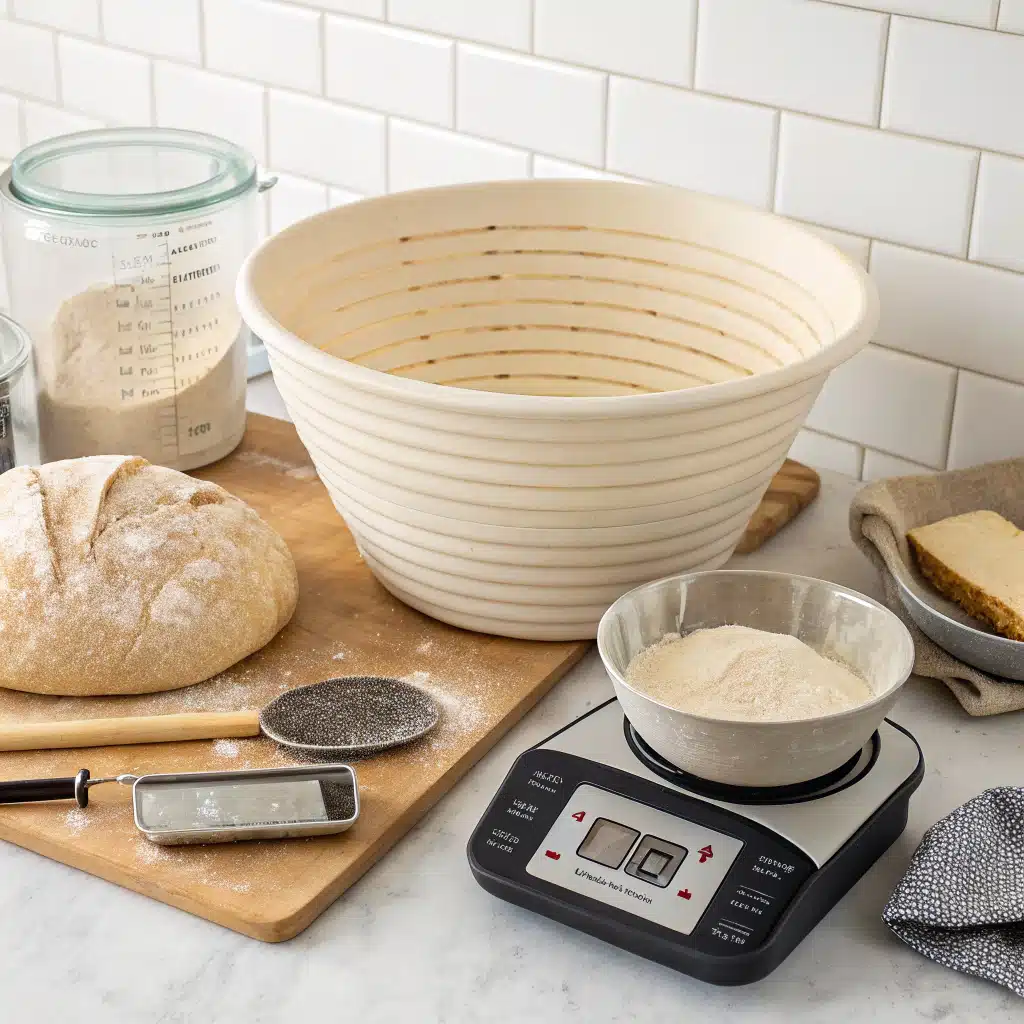
Essential Tools for Sourdough Baking (Beginner to Advanced)
Sourdough baking is often described as an art, but at its heart, it is a precise science. The difference between a flat, gummy loaf and a spectacularly airy, open-crumbed boule often comes down to consistency, and consistency is impossible without the right equipment.
While the beauty of sourdough lies in its simplicity—flour, water, salt, and time—the tools you use are critical intermediaries that help you control the variables of temperature, hydration, and fermentation. This guide breaks down the essential equipment, explaining not just *what* you need, but *why* each tool is necessary for achieving professional-quality results from your home kitchen. Whether you are nurturing your first starter or aiming for highly consistent production, the right tools are your greatest allies.
Understanding the Core Concept: Precision and Environment
The fundamental challenge in sourdough baking is managing a wild, living culture (the starter) and achieving predictable results in a variable home environment. Sourdough success is built upon two core pillars that tools help control: Precision and Environment.
**Precision** relates entirely to measurement. Unlike commercial yeast baking, where a little extra flour or water might be forgiving, sourdough recipes rely on precise ratios (hydration levels) for the starter and the final dough. If you cannot accurately measure the weight of your ingredients, you cannot reliably replicate your successes or troubleshoot your failures.
**Environment** refers to the conditions you create for the dough during bulk fermentation and baking. Tools help us manage the dough’s temperature, track its volume increase, and, most importantly, control the humidity and heat during the final oven spring. Investing in the right tools is investing in the ability to measure, track, and control these critical variables.
Key Factors and Principles: How Tools Influence Results
Every tool serves a purpose directly related to the key principles governing sourdough quality:
**1. Hydration and Dough Consistency:** A digital scale ensures exact hydration levels, which dictate dough handling, gluten development speed, and final texture.
**2. Temperature Control:** A thermometer allows you to adjust your water temperature to hit a target dough temperature (Desired Dough Temperature or DDT), which is the single most important factor for controlling fermentation timing.
**3. Fermentation Tracking:** Straight-sided containers provide a quantitative, measurable way to track volume increase, moving beyond subjective visual cues. This prevents under-proofing (dense crumb) and over-proofing (lack of oven spring).
**4. Steam Management:** Specialized baking vessels, like a Dutch oven, trap the moisture released by the dough during the initial bake. This humid environment keeps the crust pliable, allowing the loaf to expand fully (oven spring) before the crust sets.
Essential Tools for the Sourdough Starter (The Foundation)
Before you even mix your first loaf, you need the right setup for maintaining your starter.
Digital Scale: The Non-Negotiable Tool
In sourdough, volume measurements (cups and spoons) are functionally useless. Flour compresses differently depending on humidity and how it’s scooped, leading to massive inconsistencies in weight. Water density also varies slightly.
A **digital kitchen scale** accurate to at least 1 gram (and ideally 0.1 gram for small starter feeds) is essential. Sourdough recipes are written in baker’s percentages, relying on weight. If a recipe calls for 75% hydration, the scale is the only way to achieve it correctly. This precision ensures your dough has the correct structure for gluten development and fermentation.
Straight-Sided Jars and Containers
When monitoring bulk fermentation or starter activity, visual cues like bubbles are deceptive. What you need is measurable volume increase.
**Straight-sided containers** (glass jars for starters, clear food-grade plastic tubs for bulk fermentation) are vital. You can mark the starting level of the dough or starter and track the percentage increase precisely (e.g., a 50% or 100% rise). This objective tracking removes the guesswork from deciding when your dough is ready to shape, guaranteeing consistent fermentation timing.
Image Prompt 1: a realistic photo of a wide-mouth, straight-sided glass jar containing active sourdough starter, with a small rubber band wrapped around the jar marking the starting line of the starter level. A precise digital kitchen scale sits next to the jar.
Tools for Mixing and Developing the Dough

While some bakers mix by hand, a few simple tools can make the initial incorporation of ingredients much cleaner and more efficient.
The Dough Whisk (Danish Dough Whisk)
This specialized whisk features a thick wire loop design that cuts through thick, sticky doughs with minimal effort, making the initial mixing phase (incorporating the water and flour) much faster and less messy than using a spoon or even your hand. It helps achieve a shaggy mass quickly, ready for the autolyse phase.
Bench Scrapers and Bowl Scrapers
These two scraping tools are arguably more important than specialized mixers.
* **Plastic Bowl Scraper (or Dough Scraper):** Flexible and curved, this tool allows you to scrape every bit of dough from your mixing bowl, minimizing waste and ensuring a complete mix. It is also invaluable for folding and developing the dough during the early stages of bulk fermentation.
* **Metal Bench Scraper:** Used primarily for dividing the dough and cleaning your work surface. Its rigid, straight edge allows you to cleanly portion dough and lift sticky masses without tearing the delicate gluten structure.
Tools for Fermentation and Shaping
Once mixing is complete, tools are needed to hold the shape and manage the final proof.
Banneton Baskets: Managing Proofing Shape
Bannetons (or proofing baskets) provide structure during the final cold proof, preventing the dough from spreading outward and ensuring it holds a beautiful, tight shape.
* **Material Choice:** Bannetons are typically made from cane (wicker) or plastic. Cane baskets wick away a small amount of moisture from the dough surface, which helps create a thin, dry skin that contributes to a crisp crust and makes scoring easier.
* **Lining:** While many baskets come with linen liners, advanced bakers often prefer proofing the dough directly against the cane (after dusting heavily with rice flour or a 50/50 mix of white and rice flour) to maximize moisture wicking and texture transfer.
Lame (Scoring Tool)
A lame (pronounced “LAHM”) is a handle that holds a sharp razor blade, used for scoring the dough just before baking. Scoring is not just decorative; it is functional. It directs where the loaf will expand during oven spring. Using a sharp, dedicated blade prevents the dough from dragging and tearing, ensuring a clean expansion and maximizing the final rise.
Tools for Baking: Creating the Perfect Oven Environment
The final bake is where the magic happens, and the environment must be tightly controlled.
The Dutch Oven Advantage: Steam Control
For the home baker, the **Dutch oven** (a heavy, cast-iron pot with a lid) is the single most important tool for achieving a professional crust and maximum oven spring.
When the dough hits the hot Dutch oven, it releases steam. Because the lid is on, this steam is trapped around the loaf, creating a highly humid environment. This humidity keeps the outer layer of the dough cool and moist for the first 15–20 minutes of baking, delaying the setting of the crust. This delay allows the dough’s internal gases to expand fully before the structure locks, leading to a much larger, airier loaf. Once the lid is removed, the trapped heat creates rapid browning and a crisp crust.
Image Prompt 2: a realistic photo of a steaming hot, round, enameled cast iron Dutch oven sitting on a protective wooden trivet, with a freshly baked sourdough boule inside exhibiting a deep golden-brown crust and prominent ear.
Oven Thermometer
Most home ovens are inaccurate, often running 25°F to 50°F cooler or hotter than the display indicates. An inexpensive, dedicated **oven thermometer** hung inside the oven is crucial for verifying the actual temperature, ensuring your preheat is adequate and that you are baking at the temperature required for optimal crust development.
Common Mistakes and How to Avoid Them
Many common baking failures can be traced back to tool misuse or omission.
| Mistake | Cause (Tool-Related) | How to Avoid |
| :— | :— | :— |
| **Flat, Dense Loaf** | Under- or over-proofing due to guessing fermentation time. | Use a straight-sided container to track a specific percentage rise (e.g., 50%). |
| **Gummy Texture** | Incorrect hydration ratio or temperature, leading to poor gluten development. | Use a digital scale for precise ingredient weights and a thermometer for DDT. |
| **Crust Tears Randomly** | Poor scoring or crust setting too early. | Use a sharp lame for deep, deliberate scoring. Use a Dutch oven to maintain steam. |
| **Uneven Baking** | Incorrect oven temperature. | Always verify oven temperature with a dedicated oven thermometer. |
Advanced Tools for Optimization and Consistency

Once you master the basics, advanced tools can help you fine-tune your process, especially when baking in varying seasonal temperatures.
Infrared Thermometer
An infrared thermometer allows for instant, non-contact measurement of surface temperatures—useful for checking the temperature of your mixing bowl, the counter surface, or the bottom of your Dutch oven. This helps ensure your dough never comes into contact with surfaces that are too cold, which can stall fermentation.
Probe Thermometer (Dough Thermometer)
A simple digital probe thermometer is essential for measuring the internal temperature of the dough after mixing to determine the **Desired Dough Temperature (DDT)**. It is also used to check the final internal temperature of the baked loaf (ideally 208–210°F or 98–99°C) to ensure it is fully cooked and prevent a gummy interior.
Cooling Rack
While simple, a **wire cooling rack** is critical. Placing a hot loaf directly on a counter traps steam, making the bottom crust soggy. A cooling rack allows air circulation around the entire loaf, ensuring the crust remains crisp and the crumb structure sets properly as it cools. Never slice a loaf before it has cooled completely (at least 2 hours), as the internal starches are still gelatinizing.
Image Prompt 3: a realistic overhead photo showing a baked sourdough loaf resting on a wire cooling rack, with a digital probe thermometer inserted into the side of the loaf displaying a temperature reading of 209°F.
Tips, Best Practices, and Variations
* **Rice Flour for Bannetons:** Use rice flour (or a 50/50 mix of rice and white flour) for dusting your bannetons. Rice flour does not contain gluten and is less readily absorbed by the wet dough, preventing sticking better than wheat flour alone.
* **The Shower Cap Trick:** Instead of plastic wrap, use a reusable, elastic shower cap to cover your bulk fermentation container. It’s cheap, reusable, and creates an airtight seal, preventing the dough from drying out.
* **Multi-Use:** If you don’t have a Dutch oven, you can simulate the environment by baking the loaf on a preheated baking stone or steel and placing a deep, oven-safe tray filled with boiling water on the rack below to generate steam.
FAQ
Q: Can I skip the digital scale if I use measuring cups carefully?
A: No. Sourdough hydration levels are too sensitive for volume measurements. Ignoring the scale guarantees inconsistencies in dough handling and final texture. The scale is the single most important investment.
Q: Do I need a specialized proofing box?
A: A dedicated proofing box is helpful for maintaining a precise temperature in a cold kitchen, but it is not essential for beginners. A cooler with a jar of warm water inside, or simply finding a warm spot in your kitchen (like the top of the refrigerator), works perfectly well for controlling fermentation temperature.
Q: How do I clean my banneton basket?
A: Never use soap or soak a cane banneton. After use, let the basket dry completely. Once dry, use a stiff brush (like a dedicated pastry brush or toothbrush) to brush out excess flour. Store the basket in a well-ventilated area.
Conclusion
Sourdough baking is a journey of continuous learning, but the path to mastery is paved with consistency. By moving away from guesswork and embracing precision tools—the digital scale, the straight-sided container, and the Dutch oven—you gain the ability to accurately measure your inputs and control your environment. These tools provide the objective feedback necessary to understand the fermentation process and confidently adjust your methods, ensuring that your next loaf is always better than your last. Embrace your tools, track your results, and enjoy the reward of consistently exceptional homemade sourdough.