
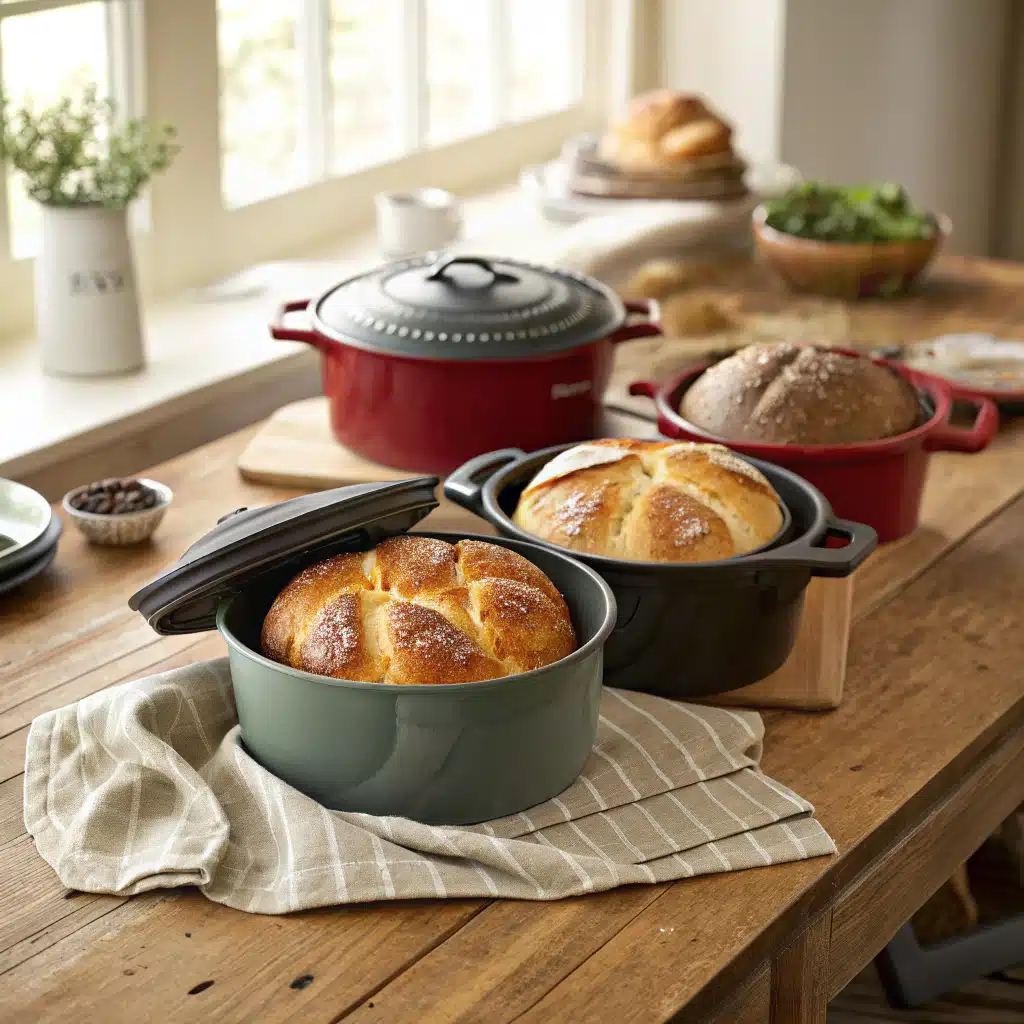
The Best Dutch Ovens for Perfect Homemade Bread
Introduction: The Secret Weapon for Superior Crust and Crumb
For many home bakers, the journey to achieving true artisan-quality bread—the kind with a deep, crackling crust and a moist, airy crumb—often hits a wall. You might be using excellent flour, mastering your fermentation, and scoring beautifully, yet the final result lacks that professional oven spring and depth of flavor. The missing link is almost always steam, and the most effective way to trap that steam in a home oven environment is through the use of a heavy, heat-retaining vessel: the Dutch oven.
This article is designed to guide you through selecting and using the ideal Dutch oven for bread baking. We will explore the science behind why these simple pots revolutionize your loaf, the key characteristics to look for when choosing one, and the practical techniques necessary to ensure safety and consistent results every time you bake.
Understanding the Core Concept: Steam is King
The primary function of the Dutch oven in bread baking is to create a closed, high-humidity environment. This is critical during the first 15 to 20 minutes of baking, known as the “oven spring” phase. When the cold dough hits the intense heat of the preheated Dutch oven, the residual moisture in the dough rapidly turns into steam.
Why is this trapped steam so important? Steam keeps the surface of the dough moist and pliable. If the crust forms too quickly—as it often does in a dry home oven—it hardens, restricting the yeast’s final push of expansion (the oven spring). By keeping the surface soft, the dough can expand maximally before the crust finally sets. This expansion results in a higher rise, a more open crumb structure, and ultimately, a much thinner, shatteringly crisp crust. Furthermore, the high heat retention of the cast iron ensures that the loaf receives even, consistent heat from all sides, promoting better color development and flavor depth.
Image Prompt 1: a realistic photo of a freshly baked sourdough loaf resting on a wire rack, showing a deep golden-brown, crackled crust and a high rise. A heavy, dark enameled cast iron Dutch oven is visible slightly blurred in the background on a stovetop.
Key Factors and Principles When Choosing a Dutch Oven

Not all heavy pots are created equal when it comes to bread baking. Several factors determine a Dutch oven’s suitability and performance.
Material and Heat Retention
The ideal material is heavy cast iron, either bare (seasoned) or enameled. Cast iron excels at absorbing and retaining heat. When you preheat the vessel for an hour or more, the cast iron acts as a heat battery, providing the necessary thermal inertia to shock the dough into rapid expansion. Ceramic or stoneware bakers can also work, but they often lack the sheer mass of cast iron and may not retain heat as effectively throughout the entire bake.
Size and Shape
For standard-sized loaves (usually 500g to 1000g of flour), a Dutch oven between 5 and 7 quarts is ideal.
* **Round vs. Oval:** A round Dutch oven is generally preferred for common boule (round) loaves. It forces the dough to rise vertically rather than spreading horizontally. Oval shapes are excellent if you frequently bake bâtards (oval loaves) or baguettes, but they can sometimes allow steam to escape more easily due to a less uniform seal.
* **Depth:** Ensure the pot is deep enough that the loaf has room to spring without touching the lid, which could lead to scorching or sticking.
Lid Fit and Handles
The lid must fit snugly to trap the steam effectively. Look for a heavy lid that sits flush with the base. Additionally, check the handles and knob. Since you will be baking at extremely high temperatures (often 450°F to 500°F or 232°C to 260°C), ensure that the lid knob is oven-safe to these temperatures. Many plastic or composite knobs on standard cookware are only rated up to 400°F and must be replaced with a metal alternative before baking bread.
Practical Methods and Techniques: Baking with the Dutch Oven
Using a Dutch oven requires a specific, safety-conscious workflow to achieve the best results.
Preheating is Non-Negotiable
The single most common mistake beginners make is insufficient preheating. Place the empty Dutch oven (base and lid) into the cold oven. Set your oven temperature to the desired high heat (e.g., 475°F or 245°C). Allow the oven and the Dutch oven to preheat for a minimum of 45 minutes, but ideally a full hour. This ensures the cast iron is thoroughly saturated with heat, not just the air inside the oven.
Transferring the Dough Safely
Working with a pot this hot requires caution. Use heavy-duty oven mitts designed for high heat.
1. **Prepare the Dough:** Your final proofed dough should be ready to bake. The easiest way to transfer the dough is using parchment paper. Gently turn the dough out onto a square of parchment paper. Score the dough immediately.
2. **Lift and Drop:** Carefully remove the scorching hot lid and set it aside. Using the parchment paper like a sling, gently lower the dough and paper into the base of the Dutch oven.
3. **Cover and Bake:** Replace the lid quickly to trap the steam.
The Two-Stage Baking Process
Baking in a Dutch oven follows two distinct stages:
1. **Covered Bake (Steam Phase):** Bake with the lid on for 20 minutes. This is when the oven spring occurs and the crust remains soft.
2. **Uncovered Bake (Crust Development Phase):** Carefully remove the lid (beware of the rush of superheated steam!) and continue baking for another 20 to 30 minutes, or until the crust is deeply golden brown and the internal temperature reaches 200°F–210°F (93°C–99°C). Removing the lid allows the trapped moisture to escape, drying the crust surface and enabling the Maillard reaction to create that desirable dark color and complex flavor.
Image Prompt 2: a close-up, overhead shot showing a baker wearing thick oven mitts carefully lowering a round of sourdough dough, resting on a square of parchment paper, into a large, preheated, dark cast iron Dutch oven. Steam is visibly rising from the hot pot.
Common Mistakes and How to Avoid Them
Even with the right equipment, small errors can derail your perfect loaf.
Mistake 1: Not Preheating Long Enough
* **The Result:** Poor oven spring, pale crust, and dense crumb because the dough cools the pot too quickly.
* **The Fix:** Always preheat for a minimum of 60 minutes. Use an oven thermometer to verify the temperature, as home ovens are often inaccurate.
Mistake 2: Baking Too Cool
* **The Result:** Slow oven spring and a thick, chewy crust.
* **The Fix:** Artisan bread requires high heat. Stick to temperatures between 450°F and 500°F (232°C–260°C). The high heat is necessary to activate the rapid gas expansion.
Mistake 3: Forgetting About the Lid Knob
* **The Result:** A melted plastic knob dripping onto your oven floor or bread.
* **The Fix:** Check the heat rating of your lid knob before using it. Replace plastic or composite knobs with a sturdy metal alternative (like a stainless steel bolt or a replacement metal knob) if baking above 400°F.
Mistake 4: Taking the Lid Off Too Soon
* **The Result:** The crust sets too early, limiting the final rise.
* **The Fix:** Keep the lid on for the full 20 minutes. Resist the urge to peek before the 20-minute mark.
Tips, Best Practices, and Variations

Enhance your Dutch oven baking with these expert tips.
The Cold Dough Advantage
If possible, proof your dough (especially high-hydration sourdough) in the refrigerator overnight. Transferring cold dough to the intensely hot Dutch oven provides a longer thermal lag, giving the dough structure more time to expand before the enzymes become too active, leading to superior shape retention and oven spring.
Using the “Combo Cooker”
A popular variation is the “combo cooker,” which is essentially a shallow skillet base and a deep pot lid. When using this setup, you preheat both parts and place the dough onto the shallow skillet base. You then invert the deep pot lid over the dough. This setup is safer and easier for transferring delicate dough, as you don’t have to drop the dough down into a deep, hot vessel.
Managing Sticky Doughs
If your dough is very sticky, you can dust the bottom of the Dutch oven (or the parchment paper) with a thin layer of cornmeal or rice flour before placing the dough inside. This acts as tiny ball bearings, preventing sticking and ensuring easy removal after baking.
Image Prompt 3: a realistic photo of a large, seasoned cast iron skillet (the base of a combo cooker) holding a perfectly proofed and scored sourdough loaf, ready to be covered. The deep cast iron pot (the lid) is resting inverted nearby.
FAQ: Your Dutch Oven Baking Questions Answered
1. Do I need an enameled or bare cast iron Dutch oven?
Both work exceptionally well. Enameled cast iron is easier to clean and requires no seasoning, but it is often more expensive. Bare, seasoned cast iron may develop a better non-stick surface over time and is slightly more durable at extreme temperatures. Choose based on your budget and maintenance preference.
2. Can I bake multiple loaves back-to-back?
Yes, but you must allow the Dutch oven to reheat fully between loaves. After removing the first loaf, place the lid back on, return the Dutch oven to the oven, and allow it to preheat for at least 20–30 minutes before loading the next loaf.
3. How do I clean burned residue from my Dutch oven?
For enameled cast iron, use a paste of baking soda and a non-abrasive scrubber. For bare cast iron, scrape gently with a wooden or metal spatula while the pot is warm, then re-season lightly with oil. Never use soap on bare cast iron, and avoid sudden temperature changes on enameled pots to prevent cracking.
Conclusion: Investing in Your Baking Future
The Dutch oven is more than just a piece of cookware; it is a dedicated tool that bridges the gap between a standard home oven and a professional brick hearth. By understanding the core principle—the necessity of trapped steam for maximum oven spring and a superior crust—and committing to the high-heat, two-stage baking process, you unlock a new level of quality in your homemade bread. Choose a heavy, appropriately sized vessel, prioritize safety during transfer, and commit to the full preheat, and you will consistently pull perfect, crusty, and complex loaves from your oven every time.