
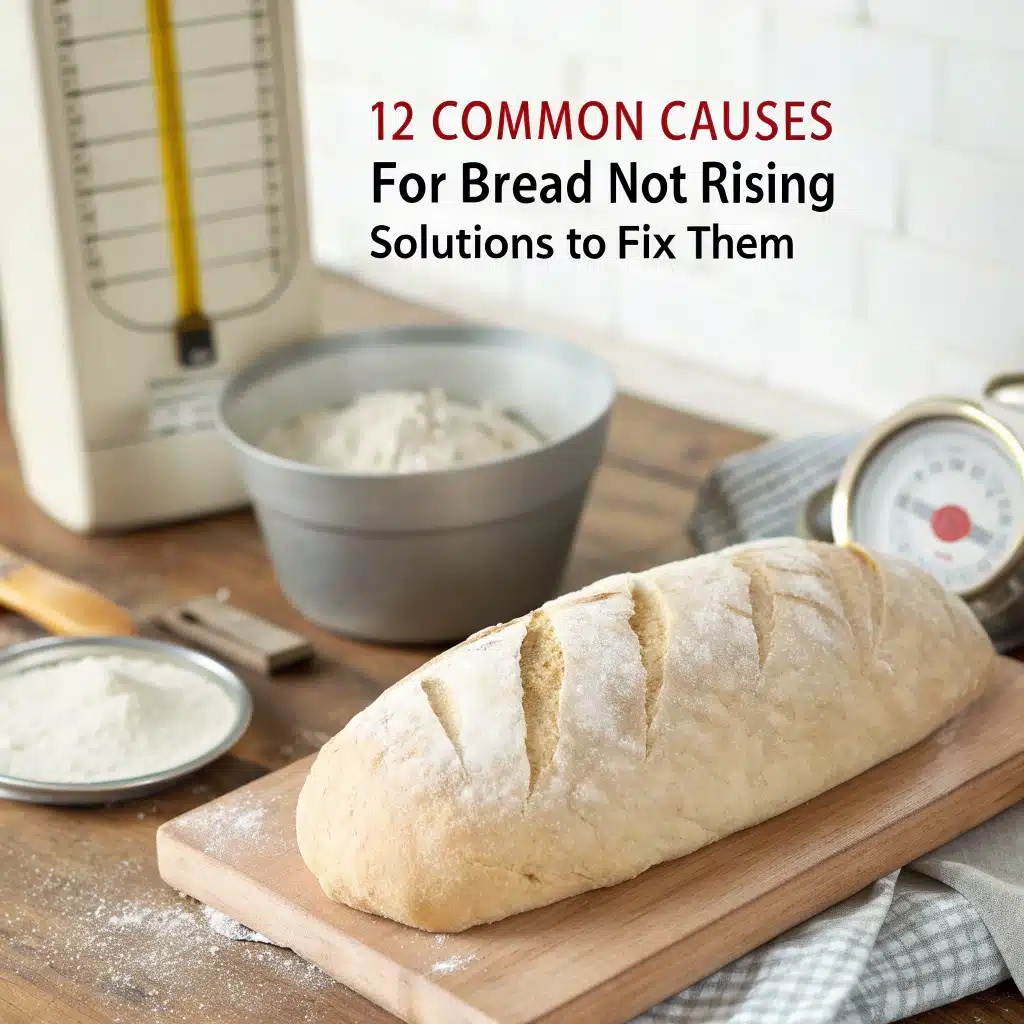
Why Your Bread Didn’t Rise: 12 Common Causes and How to Fix Them
There is little that compares to the satisfaction of pulling a perfectly golden, high-loaved bread from the oven. Conversely, few things are as disheartening as checking your dough after hours of waiting only to find a dense, lifeless lump. If your bread consistently fails to rise, it’s not bad luck—it’s a sign that one or more critical steps in the complex process of fermentation have been missed or mismanaged.
Bread making is a science governed by temperature, time, and precise ratios. Understanding the fundamental mechanics of the rise is the key to consistent success. This guide, written for home bakers, will dissect the 12 most common reasons why your dough stays flat and provide actionable, expert solutions to ensure a beautiful rise every time.
Understanding the Core Concept: The Science of the Rise
The rise, or leavening, of bread is driven by a biological process called fermentation. This process relies on the microscopic work of yeast (Saccharomyces cerevisiae).
When yeast is activated by moisture and fed carbohydrates (sugars found in flour), it produces two main byproducts: ethanol (alcohol) and carbon dioxide (CO2) gas. This CO2 gas is what inflates the dough.
However, the gas needs to be trapped. This is where gluten comes in. Gluten is a network of proteins (glutenin and gliadin) formed when flour and water are mixed and kneaded. This elastic, stretchable structure acts like a balloon, trapping the CO2 bubbles produced by the yeast, causing the dough to expand—this is the rise. If the yeast is inactive or the gluten network is weak, the dough will not inflate.
Image Prompt 1: A close-up, realistic photo of a clear glass bowl containing warm water, sugar, and active dry yeast that is blooming, showing a thick layer of creamy foam and bubbles on the surface, demonstrating a successful yeast proof.
Key Factors and Principles: The 12 Reasons for Failure

The causes of a failed rise can be grouped into four primary categories: yeast viability, temperature control, dough structure, and ingredient balance.
Yeast Viability: Causes 1–3
Yeast is a living organism, and its activity is highly sensitive to its environment.
1. The Water Was Too Hot (Killing the Yeast)
Yeast dies rapidly when exposed to temperatures exceeding 130°F (54°C). If you used tap water that felt too hot to the touch, you likely scorched and killed the yeast before it could begin fermentation.
2. The Water Was Too Cold (Dormancy)
Yeast becomes sluggish or dormant in water below 70°F (21°C). While cold water won’t kill the yeast, it will drastically slow down fermentation, leading to a rise that takes far too long or appears nonexistent.
3. The Yeast Was Old or Expired
Yeast has a shelf life. Over time, the living cells die off, resulting in less leavening power. If your yeast container has been open for months or is past its expiration date, its viability may be compromised.
Ingredient Balance and Measurement: Causes 4–6
Precision in baking is paramount. Even slight mismeasurements can sabotage the entire process.
4. Too Much Salt (The Yeast Inhibitor)
Salt is essential for flavor and for controlling the speed of fermentation, but it is also a powerful yeast inhibitor. If you accidentally double the salt or allow it to come into direct, prolonged contact with the yeast before mixing, the salt draws moisture out of the yeast cells via osmosis, effectively dehydrating and killing them.
5. Incorrect Flour-to-Water Ratio (Hydration Issues)
If you use too much flour, the dough will be stiff and dry. A dry, low-hydration dough creates a dense, restrictive gluten network that cannot stretch sufficiently to capture the CO2 gas. This results in a heavy, small loaf.
6. Using the Wrong Type of Flour
All-purpose flour works for many recipes, but for high-volume loaves, you need high-protein bread flour. Bread flour contains 12–14% protein, which develops stronger, more elastic gluten than the 10–11% found in all-purpose flour. Weak gluten cannot hold the CO2, leading to a dough that spreads outward rather than rising upward.
Temperature and Environment Issues: Causes 7–8
Temperature is the single greatest variable in home baking.
Image Prompt 2: A professional kitchen scene showing a stainless steel mixing bowl containing dough, resting on a counter next to a digital kitchen thermometer accurately reading the internal temperature of the dough, highlighting the importance of temperature control.
7. The Environment Was Too Cold (Stalled Fermentation)
The ideal temperature range for bulk fermentation (the first rise) is 75–80°F (24–27°C). If your kitchen is cold (e.g., 65°F or 18°C), the yeast activity will dramatically slow down. The rise will take hours longer than expected, or appear not to happen at all.
8. The Environment Was Too Hot (Over-Fermentation and Collapse)
While warmth encourages yeast, excessive heat (above 85°F or 30°C) can cause the yeast to ferment too quickly. Rapid fermentation exhausts the yeast’s food supply, and the strong rush of CO2 can cause the gluten structure to tear. If the dough rises quickly and then suddenly deflates or collapses, it was likely over-proofed due to high temperature.
Dough Structure and Kneading: Causes 9–12
The structure of the dough dictates its ability to hold the rise.
9. Insufficient Kneading (Weak Gluten)
Kneading is the process that aligns and develops the gluten strands. Under-kneaded dough lacks the elasticity and strength necessary to trap gas. The bubbles will escape, leaving you with a dense, crumbly texture.
10. Over-Kneading (Torn Gluten)
While rare when kneading by hand, using a stand mixer on high speed for too long can overwork the dough. This shears the developed gluten strands, making the dough slack, sticky, and unable to hold its shape or the CO2 gas.
11. Skipping the Second Rise (Insufficient Volume)
Most recipes require a bulk fermentation (first rise) followed by shaping, and then a proofing stage (second rise). The second rise builds final volume and creates the desired open crumb structure. Skipping this step leads to a dense loaf.
12. Mistaking Oven Spring for a Rise
Oven spring is the final, rapid expansion of the dough within the first 10–15 minutes of baking. If your dough enters the oven flat, the oven spring alone cannot save it. The dough must be adequately proofed *before* it goes into the heat.
Practical Methods and Techniques for Consistent Rising
To ensure your dough rises successfully, implement these essential techniques:
1. Always Proof Your Yeast
If you use active dry yeast, or if you are unsure of your yeast’s age, perform the “proof test.” Mix the yeast with a teaspoon of sugar and 1/2 cup of warm water (95–105°F or 35–40°C). Wait 5–10 minutes. If a thick, creamy foam develops, the yeast is active. If nothing happens, replace the yeast.
2. Master Dough Temperature Control
Use a digital thermometer to measure your water temperature precisely. Furthermore, aim to achieve a Final Dough Temperature (FDT) of 75–78°F (24–25.5°C) immediately after mixing. This ensures yeast activity starts immediately and consistently.
3. Use the Windowpane Test
To check if your dough is sufficiently kneaded, perform the windowpane test. Pinch a small piece of dough and gently stretch it. If you can stretch it thin enough to see light through it without tearing, the gluten is properly developed. If it tears easily, keep kneading.
Image Prompt 3: A baker’s hands gently stretching a small piece of well-kneaded bread dough, holding it up so that light shines through the thin, translucent membrane, demonstrating a perfect “windowpane test” in a naturally lit kitchen.
Common Mistakes and How to Avoid Them
The Mistake: Mixing Salt and Yeast Directly
Many bakers toss all dry ingredients into the bowl simultaneously. If the salt is poured directly onto the yeast, it can compromise the yeast’s integrity before the water and flour dilute the concentration.
**The Fix:** Always dissolve the yeast in water (if using active dry) or mix the yeast thoroughly into the flour first. Then, add the salt on the opposite side of the bowl or mix it into the remaining flour before hydrating.
The Mistake: Relying on Recipe Time, Not Dough Condition
A recipe might state the first rise takes 1.5 hours. If your kitchen is cold, it might take 3 hours. Beginners often stop based on the clock, resulting in under-proofed dough.
**The Fix:** Judge the rise by condition, not time. The bulk fermentation is complete when the dough has visibly increased in volume (usually 1.5 to 2 times its original size) and looks airy and domed. Use the “poke test”: gently poke the dough. If the indentation slowly springs back halfway, it is ready. If it springs back immediately, it needs more time. If it collapses, it is over-proofed.
The Mistake: Using a Cold Metal Bowl
A cold mixing bowl or cold counter can rapidly drop the temperature of your newly mixed dough, stalling the yeast activity.
**The Fix:** Warm your mixing bowl slightly before use, especially in winter. You can do this by rinsing it with hot water and drying it immediately before adding ingredients.
Tips, Best Practices, and Variations

The Autolyse Technique
For stronger gluten development and better hydration, try the autolyse technique. Mix only the flour and water and let them rest for 20–30 minutes before adding the yeast and salt. This allows the flour to fully hydrate and enzyme activity to begin, leading to a smoother, easier-to-handle dough and a better rise.
Creating a Warm Proofing Environment
If your kitchen is cold, create a makeshift proofing box:
1. Place the dough bowl inside your oven (turned off).
2. Place a pan of boiling water on the rack below the dough.
3. The steam and warmth will create an ideal environment of 75–85°F (24–30°C).
FAQ
Can I save dough that failed to rise?
If the dough didn’t rise because the yeast was dead (too hot water), unfortunately, no. You must start over with fresh, active yeast. If the dough failed to rise because the environment was too cold or it was under-kneaded, you can salvage it. Warm the dough up or knead it for a few more minutes, and then give it more time.
How do I know if my dough is over-proofed?
Over-proofed dough looks puffy, feels fragile, and often smells intensely sour or alcoholic. If you poke it, the indentation will not spring back at all, and the dough may deflate slightly. While slightly over-proofed dough is often salvageable, severely over-proofed dough should be reshaped and baked immediately, though the resulting loaf will likely be dense.
Should I cover the dough while it rises?
Yes, always cover your dough tightly, usually with plastic wrap or a damp kitchen towel. This prevents a dry skin or crust from forming on the surface. A dry crust restricts the dough’s ability to expand evenly, leading to an uneven or stunted rise.
Conclusion
The secret to a successful rise lies in managing the yeast, controlling the temperature, and developing the gluten structure. By understanding these 12 common pitfalls—from water temperature to the windowpane test—you gain control over the fermentation process. Don’t view a flat loaf as a failure, but as a diagnostic tool. Apply these fixes consistently, pay close attention to the feel and temperature of your dough, and you will soon be rewarded with the tall, airy loaves you’ve been aiming for. Happy baking!