
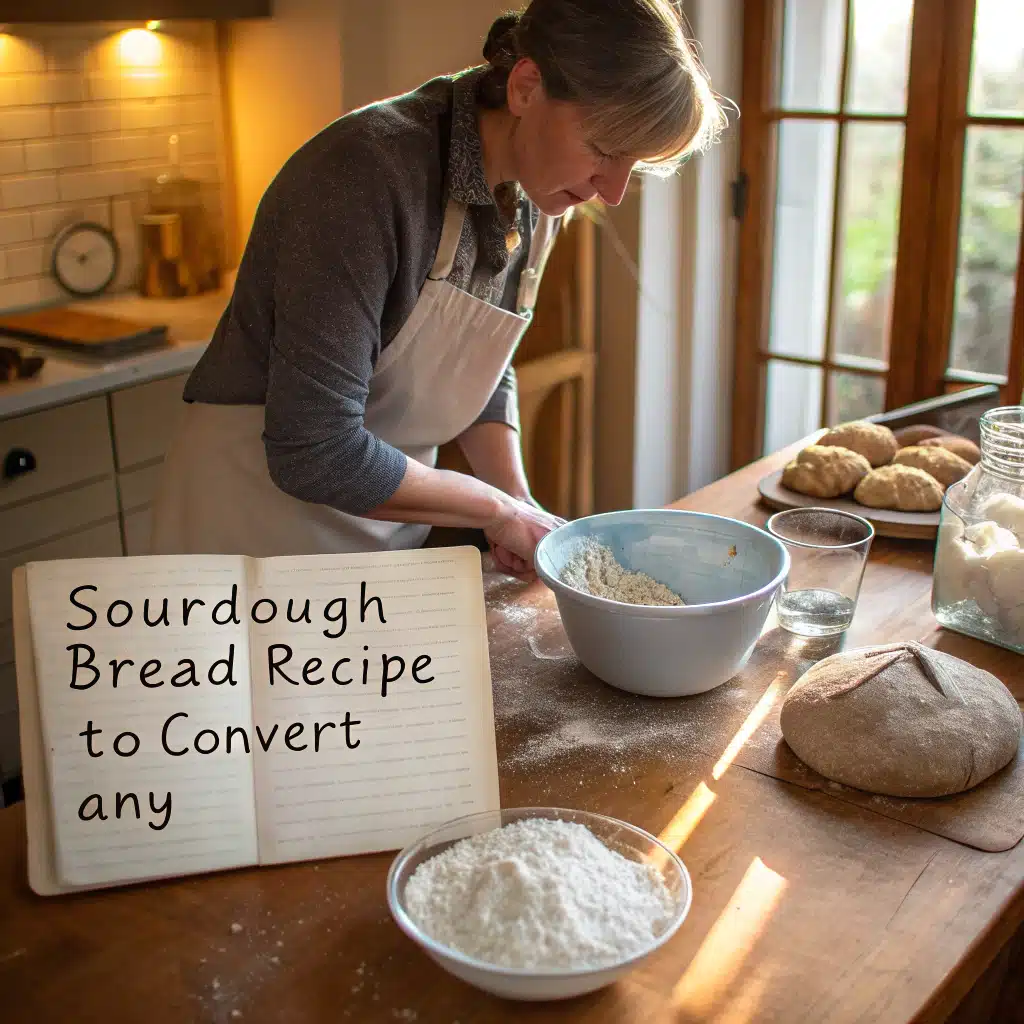
How to Convert Any Bread Recipe to a Sourdough Version
For many home bakers, mastering sourdough feels like reaching the pinnacle of the craft. But what happens when you discover a fantastic, high-hydration focaccia or a perfect cinnamon roll recipe that relies solely on commercial yeast? Do you have to abandon it?
Absolutely not.
The true secret to unlocking endless bread possibilities lies in understanding how to substitute active dry yeast (ADY) or instant yeast (IY) with a living sourdough culture (often called a levain or starter). This conversion process is less about guesswork and more about precise mathematical accounting and a fundamental shift in your approach to fermentation time.
Converting a conventional yeast recipe to sourdough allows you to infuse those traditional flavors—the complex acidity, the depth of flavor, and the superior keeping qualities—into any dough structure, from soft sandwich loaves to crisp baguettes. This guide breaks down the essential science and provides the practical steps needed to successfully sourdough-ify any recipe in your repertoire.
Understanding the Core Concept: The Levain Exchange
The most common mistake when converting a recipe is treating sourdough starter as a magical ingredient that simply replaces yeast powder. In reality, a sourdough starter is a living culture consisting of equal parts flour and water (assuming a standard 100% hydration starter).
When a recipe calls for 7 grams of instant yeast, you are adding only the yeast culture. When you add 100 grams of sourdough starter, you are adding the yeast culture *plus* 50 grams of flour and 50 grams of water.
The core concept of conversion is simple: you must mathematically subtract the flour and water contained within your starter from the total flour and water called for in the original recipe. This ensures the final dough maintains the exact hydration percentage (moisture level) and overall ingredient ratios intended by the original baker.
Image Prompt 1: A close-up, realistic photo of a mature, active sourdough starter in a clear glass jar, showing many bubbles and a slightly domed surface, indicating peak readiness. The lighting is warm and natural.
Key Factors in Sourdough Conversion

Successfully transitioning a recipe requires focusing on three primary factors that dictate the final texture and flavor of the loaf.
Hydration Balance: The Water and Flour Accounting
Hydration is the single most critical factor in conversion. If you fail to adjust the recipe’s flour and water content, your final dough will be significantly wetter than intended, leading to a flat, dense, or unmanageable crumb.
* **The Goal:** Maintain the original dough’s total hydration percentage.
* **The Calculation:** If you use 150 grams of 100% hydration starter, you must subtract 75 grams of flour and 75 grams of water from the recipe’s main ingredients list.
If your starter is 80% hydration (less common, but possible), the math changes, making 100% hydration starters the easiest to work with for conversions. Always know your starter’s hydration level before beginning.
The Fermentation Timeline Shift
Commercial yeast is a powerful, highly concentrated monoculture designed to work quickly and predictably. Wild yeast and bacteria in a sourdough starter are slower, more delicate, and require significantly more time to produce the same amount of gas (rise).
A yeast-based recipe that requires a 90-minute bulk fermentation might require 4 to 6 hours when converted to sourdough, depending on ambient temperature. This extended fermentation is not a bug; it’s a feature. The slower process allows the lactic acid bacteria (LAB) to produce the complex flavors that define sourdough.
* **Actionable Insight:** Ignore the timing instructions in the original recipe entirely. Instead, focus on visual cues—the dough’s volume increase (aiming for a 30% to 50% rise during bulk) and its texture (gassy, jiggly, and passing the windowpane test).
Gluten Structure and Acidity
Sourdough starters are acidic. This acidity is wonderful for flavor, but it can sometimes weaken the gluten network if the fermentation is allowed to go too long, leading to dough that tears easily or spreads out during baking.
To counteract this, sourdough conversions often benefit from gentler handling and potentially a slightly longer autolyse period (mixing just the flour and water before adding the starter and salt) to ensure maximum water absorption and gluten relaxation before the acid starts its work.
Practical Methods and the Conversion Formula
There is no single “right” amount of starter to use, but a good starting point for most conversions is replacing the yeast with a levain that equals 15% to 25% of the total flour weight in the recipe. Higher percentages result in faster fermentation; lower percentages result in slower fermentation and more complex flavor development.
Let’s use a hypothetical recipe to demonstrate the conversion steps:
**Original Recipe:** 500g Flour, 350g Water, 10g Salt, 7g Instant Yeast. (70% Hydration)
Step 1: Calculate the Levain Weight
We will aim for a 20% starter inclusion based on the 500g flour weight.
* 500g (Total Flour) x 0.20 = 100g Levain needed.
Step 2: Adjusting Water and Flour
Since we are using 100g of 100% hydration starter, this starter contains:
* 50g Flour
* 50g Water
Now we subtract these amounts from the original recipe’s main ingredients:
| Ingredient | Original Amount | Subtraction (from Starter) | New Sourdough Amount |
| :— | :— | :— | :— |
| Flour | 500g | – 50g | 450g |
| Water | 350g | – 50g | 300g |
| Salt | 10g | – 0g | 10g |
| **Starter** | 0g | + 100g | 100g |
**New Sourdough Recipe:** 450g Flour, 300g Water, 10g Salt, 100g Starter.
The total flour (450g + 50g) is still 500g, and the total water (300g + 50g) is still 350g. The hydration remains 70%.
Step 3: Integrating the Sourdough Schedule
Once the ingredients are balanced, you must shift your process from the rapid yeast schedule to the slow, intentional sourdough schedule.
1. **Mixing:** Combine the adjusted flour, water, and levain. Allow a 30–60 minute autolyse if the recipe allows. Add the salt last.
2. **Bulk Fermentation:** Perform bulk fermentation at room temperature (ideally 75°F to 80°F, 24°C to 27°C). Use stretch and folds or coil folds every 30–45 minutes for the first 2–3 hours to build strength. Monitor the dough volume, not the clock. Bulk fermentation typically takes 4–6 hours until the dough is visibly bubbly and has increased by 40%.
3. **Shaping and Cold Proofing:** Shape the dough and immediately place it in the refrigerator (40°F / 4°C) for a long, cold proof (12–18 hours). This significantly improves flavor and tightens the gluten structure, making the dough easier to score and handle.
Image Prompt 2: A realistic, overhead kitchen photo showing a baker gently performing a coil fold on a large mass of dough resting in a clear, square container during bulk fermentation. The dough is slightly bubbly, and the surface is smooth.
Common Mistakes and How to Avoid Them
The primary pitfalls in sourdough conversion stem from impatience and inaccurate assessment of the starter’s power.
Mistake 1: Not Accounting for Hydration
* **The Error:** Simply replacing the yeast with the starter without adjusting the flour and water content.
* **The Fix:** Always use the subtraction formula outlined above. If you are unsure, start with a lower hydration recipe (65%–70%) until you are comfortable with the math.
Mistake 2: Relying on the Clock, Not the Dough
* **The Error:** Cutting the bulk fermentation short because the original recipe said to only wait 90 minutes.
* **The Fix:** Throw away the clock. Focus on signs of fermentation: the dough should feel lighter, jiggly, and show significant air bubbles on the sides of the container. If it doesn’t look ready, it isn’t.
Mistake 3: Using a Weak or Cold Starter
* **The Error:** Using starter straight from the fridge or a starter that hasn’t fully peaked after feeding.
* **The Fix:** Ensure your levain is fed 4–8 hours before mixing and is at its peak activity (usually when it has doubled and is slightly domed) before incorporating it into the dough. Using a cold starter will severely slow down the initial fermentation phase.
Tips, Best Practices, and Variations

Once you master the basic conversion, you can apply these advanced techniques to refine your results.
Using the Autolyse Method
For recipes with high percentages of whole grains, an autolyse (mixing the flour and water 30–60 minutes before adding the starter and salt) is highly beneficial. It allows the flour to fully hydrate and the enzymes to begin breaking down starches, leading to better extensibility and a smoother dough texture, which is particularly helpful when managing the acid content of sourdough.
Adapting Enriched Doughs (Brioche, Challah)
Enriched doughs (which contain high amounts of butter, eggs, and sugar) present a unique challenge, as these ingredients inhibit fermentation.
1. **Increase Starter Percentage:** Use a slightly higher percentage of starter (closer to 25% of the flour weight) to compensate for the inhibitory effect of the fat and sugar.
2. **Mix in Stages:** Mix the flour, water, starter, and other liquids first. Allow the dough to reach moderate gluten development before slowly adding the butter. Adding butter too early coats the flour particles and prevents proper hydration.
3. **Warmer Bulk Fermentation:** Enriched sourdough benefits greatly from a slightly warmer bulk fermentation (up to 82°F / 28°C) to ensure the wild yeast can work efficiently despite the heavy load of ingredients.
Image Prompt 3: A realistic, close-up photo of a beautifully braided sourdough challah or brioche loaf, baked to a deep golden brown, sitting on a cooling rack in a kitchen setting. The texture shows a soft, airy crumb structure.
FAQ
How much faster does a warmer kitchen make the process?
Temperature is the biggest variable. Raising the dough temperature from 70°F (21°C) to 80°F (27°C) can easily cut the bulk fermentation time in half. Always aim for consistency; using a proofing box or the oven with the light on helps maintain the ideal range of 75°F to 80°F.
Why is my converted sourdough recipe denser than the yeast version?
Density usually results from one of two issues: either the dough was under-fermented (it didn’t produce enough gas to open the crumb) or the hydration was miscalculated, resulting in a dough that was too stiff. Ensure you are allowing adequate bulk fermentation time and double-check your flour and water adjustments.
Can I convert a recipe that uses a pre-ferment (like a poolish or biga)?
Yes, but the math becomes slightly easier. A poolish or biga is an already fermented mix of flour and water. Instead of calculating the starter against the total flour, you can often directly substitute the weight of the pre-ferment with your mature sourdough levain, provided the hydration levels are similar (or adjust the main dough hydration slightly if they differ).
Conclusion
Converting a yeast recipe to a sourdough version is one of the most rewarding skills a home baker can acquire. It transforms your recipe library from limited commercial yeast options to virtually limitless sourdough potential. The key to success is moving past the fear of math and embracing the patience required by wild yeast.
Remember the cardinal rules: account for the flour and water in your starter, and always judge fermentation by the dough’s readiness, not the clock. Start with a simple, low-hydration recipe, master the conversion formula, and soon you will be able to infuse that signature sourdough tang into any baked good you desire. Happy baking!