
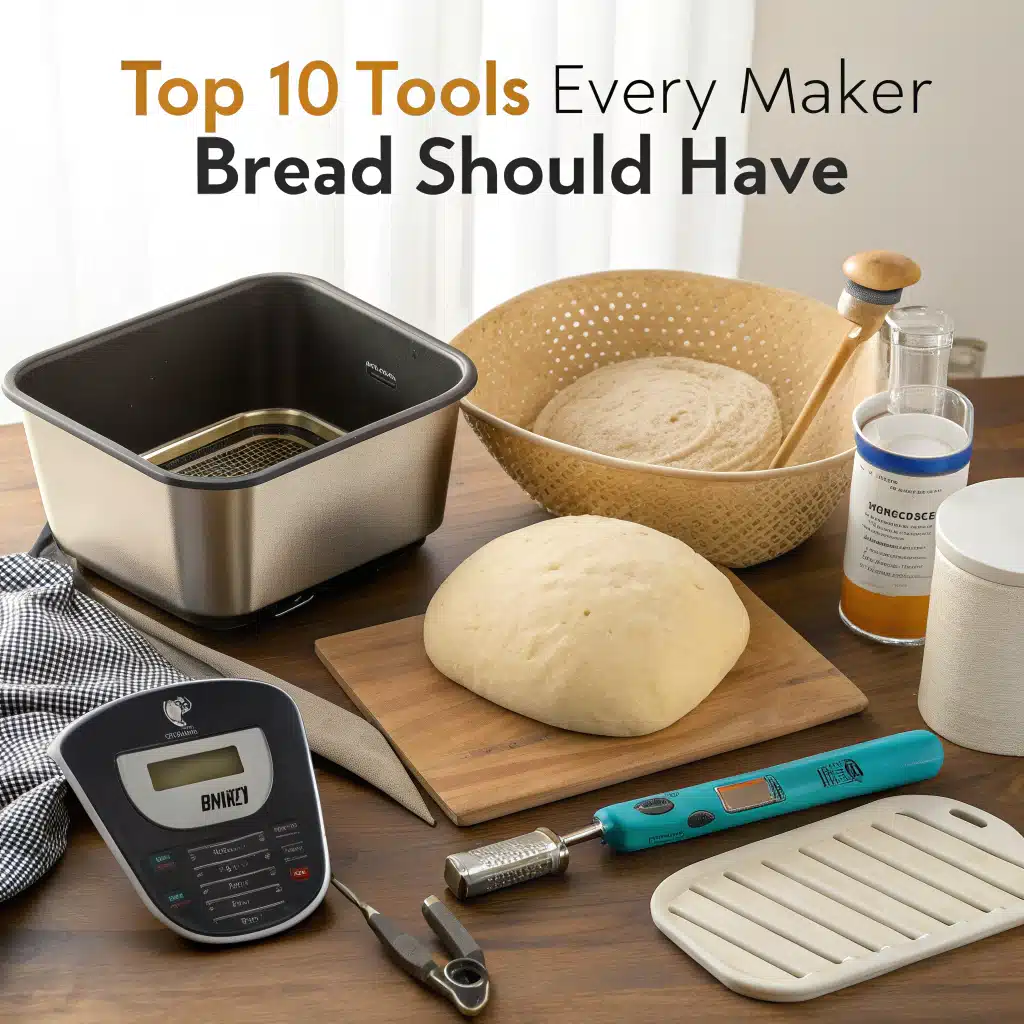
Top 10 Tools Every Bread Maker Should Have
Bread baking is often described as a magical process, but at its heart, it is precise kitchen chemistry. While the core ingredients—flour, water, yeast, and salt—are humble, the quality of the final loaf hinges on accuracy, temperature control, and proper dough handling.
For home bakers transitioning from occasionally successful loaves to consistently perfect crumb structures and golden crusts, the secret lies not in expensive machinery, but in acquiring a few fundamental, high-value tools. These instruments are extensions of the baker’s skill, providing the necessary control over the variables that define great bread. This guide details the ten essential tools that will fundamentally transform your baking results, offering authority, consistency, and confidence in every batch.
Understanding the Core Concept: Precision and Control
The primary difference between a good loaf and a great loaf is process control. Unlike general cooking where a pinch of this or a dash of that often works, bread baking relies on specific ratios and timelines. The core concept driving the need for specialized tools is the management of hydration and fermentation.
Hydration, the ratio of water to flour by weight, dictates the texture and handling properties of the dough. Fermentation, the process by which yeast creates gases and organic acids, is highly sensitive to temperature. Without the right tools, achieving the necessary precision in measurement and environment is impossible, leading to inconsistent gluten development, unpredictable rise times, and lackluster results. The tools we champion below directly address these two critical variables, transforming guesswork into repeatable science.
Image Prompt 1: A close-up, top-down realistic photo of a digital kitchen scale displaying a precise measurement (e.g., 250.0g), with a bowl of white bread flour resting on the scale platform. The lighting is bright and natural.
Key Factors and Principles Enabled by the Right Tools

The efficacy of your tools is directly tied to the fundamental principles of bread making:
Accuracy in Measurement (Weight vs. Volume)
Flour compacts differently depending on how it is scooped, meaning a “cup” of flour can vary by as much as 30 grams. This variability is disastrous for high-hydration doughs (like sourdough or ciabatta). Tools that measure by weight (like a digital scale) eliminate this variance, ensuring your hydration percentage is exact every single time, which is crucial for predictable gluten development.
Temperature Management
Yeast activity is directly correlated with temperature. Dough that is too cold ferments slowly, leading to underdeveloped flavor; dough that is too hot ferments too quickly, resulting in a dense crumb and sour flavors. Tools that measure temperature (instant-read thermometers) allow the baker to control the “dough temperature” (or desired dough temperature, DDT), ensuring consistent fermentation schedules regardless of ambient kitchen conditions.
Gentle Dough Handling
As gluten develops, the dough becomes sticky, elastic, and fragile. High-hydration doughs, especially, require careful manipulation to preserve the gas bubbles created during fermentation. Specialized scrapers and baskets prevent tearing the delicate gluten network, ensuring maximum oven spring and an open crumb structure.
Practical Methods and Techniques: The Top 10 Tools
These ten tools are categorized by their primary function, offering the backbone necessary for consistent, high-quality bread production.
1. The Digital Kitchen Scale
This is non-negotiable. A scale allows you to measure ingredients by weight (grams or ounces) rather than volume (cups or spoons). Using weight ensures mathematical precision, which is the cornerstone of successful bread baking, especially when working with baker’s percentages and calculating hydration.
2. The Instant-Read Thermometer
Use this to measure the temperature of your water, your flour, and, most importantly, your mixed dough. Aiming for a consistent final dough temperature (typically 75–78°F or 24–25°C) ensures that fermentation proceeds along the expected timeline. It’s also invaluable for checking the internal temperature of the baked loaf (205–210°F or 96–99°C) to confirm doneness.
3. The Bench Scraper (Dough Cutter)
Often a rectangular piece of stainless steel or stiff plastic, the bench scraper is essential for dividing dough into portions, cleaning flour off the work surface, and, crucially, helping to turn and fold sticky doughs without tearing the gluten or coating your hands in flour. It allows the baker to maintain control and shape without excessive sticking.
4. The Bowl Scraper (Flexible Scraper)
A flexible, curved plastic scraper perfectly conforms to the shape of your mixing bowl. Its primary use is minimizing waste and ensuring all ingredients are fully incorporated during the initial mix. It is also excellent for gently coaxing high-hydration dough out of the mixing bowl onto the bench for shaping.
5. Proofing Baskets (Bannetons)
These cane or plastic baskets provide crucial structural support for the shaped loaf during its final proof (fermentation). They prevent the dough from spreading outward, forcing it to develop vertical tension. This tension translates directly into better oven spring and a taller, more attractive final loaf. Always dust them generously with rice flour to prevent sticking.
Image Prompt 2: A realistic photo showing a baker gently scoring the surface of a prepared sourdough loaf resting on parchment paper using a small, specialized lame (razor blade holder). The focus is sharp on the scoring action, showing the clean cut.
6. The Dutch Oven or Baking Vessel
For home bakers without professional steam injection ovens, a heavy-lidded vessel (like a cast iron Dutch oven or enameled cast iron pot) is the simplest way to replicate a professional baking environment. The sealed lid traps the moisture released by the dough, creating a humid microclimate. This steam keeps the crust soft initially, allowing the loaf to expand fully before the crust sets, leading to maximum oven spring and a thinner, crisper crust.
7. The Bread Lame (Scoring Tool)
A lame (pronounced “LAHM”) is simply a handle holding a sharp razor blade. Scoring—making intentional cuts on the surface of the dough just before baking—is essential for controlling where the dough expands. A dull knife will drag and deflate the dough; a razor-sharp lame ensures a clean cut that directs the oven spring precisely, leading to the desired “ear” or bloom.
8. Large, Clear Mixing Bowls
While any bowl can mix dough, large bowls (at least 6-quart capacity for a standard loaf) are necessary to accommodate the volume increase during fermentation, especially during the bulk proof. Clear, straight-sided containers are best because they allow the baker to visually monitor the dough’s rise, making it easy to judge when the dough has doubled or increased by 50%—a key visual cue for fermentation timing.
9. The Fine-Mist Spray Bottle
If you are not using a Dutch oven, a spray bottle filled with water is essential for creating steam in the oven. Spraying the oven walls and floor immediately after loading the bread helps keep the crust moist, delaying crust formation and promoting better oven spring. A fine mist is necessary to avoid soaking the dough.
10. The Wire Cooling Rack
Perhaps the most underrated tool. Once the bread is baked, it must be cooled completely—typically 1 to 2 hours—on an open wire rack. Placing a hot loaf on a solid surface traps steam, causing the bottom crust to become soggy and rubbery. The rack allows air circulation around the entire loaf, ensuring a crisp, dry crust and allowing the internal structure (the crumb) to set properly.
Common Mistakes and How to Avoid Them
Even with the right tools, misuse can lead to poor results.
Mistake 1: Relying on Cup Measurements for Water and Flour
**Why it’s wrong:** As noted, volume measurements are inherently inaccurate.
**How to avoid it:** Commit to using the digital scale for *all* ingredients, including liquids. Water is 1 gram per 1 milliliter, making scaling water just as easy as flour.
Mistake 2: Ignoring Dough Temperature
**Why it’s wrong:** Ambient kitchen temperature varies wildly, skewing fermentation times. If the recipe calls for 4 hours of bulk fermentation, but your dough is 10 degrees too warm, it might be over-proofed in 2.5 hours.
**How to avoid it:** Use the instant-read thermometer to check your water temperature before mixing and the final dough temperature after mixing. Adjust the water temperature (hotter or colder) to hit your target DDT.
Mistake 3: Over-Dusting the Bench
**Why it’s wrong:** Excessive flour on the bench creates a dry layer on the exterior of the dough, preventing the dough from sealing properly during shaping. This results in poor surface tension and a loaf that spreads rather than springs vertically.
**How to avoid it:** Rely on the bench scraper and minimal water (or oil) on your hands to handle sticky doughs, reserving flour primarily for dusting the banneton and the final shaping surface.
Image Prompt 3: A realistic photo of a freshly baked, crusty artisan sourdough loaf cooling on a simple wire rack on a wooden countertop. Steam is visibly rising subtly from the hot loaf.
Tips, Best Practices, and Variations

To maximize the benefit of your tools, integrate these best practices:
* **Thermometer Versatility:** Use your instant-read thermometer not just for dough, but also to verify the accuracy of your oven’s thermostat. Oven temperatures are notoriously unreliable, and knowing the true temperature can prevent burnt bottoms or underbaked centers.
* **The Rice Flour Secret:** When dusting proofing baskets, use rice flour instead of wheat flour. Rice flour is pure starch and does not contain gluten, making it far less likely to stick to the moist dough surface, ensuring a clean release before baking.
* **Maintenance of the Dutch Oven:** Preheat your Dutch oven inside the oven during the entire preheating phase (usually 45–60 minutes) to ensure it is screaming hot. Placing cold dough into a hot vessel provides the necessary thermal shock for maximum oven spring.
* **Scraper Sanitation:** Always keep your bench scraper clean and slightly damp when working with very sticky doughs. This slight moisture acts as a barrier, allowing you to slide the scraper under the dough without it sticking.
FAQ
Q: Do I really need a special bread lame for scoring? Can’t I just use a sharp knife?
A: While you can use a very sharp paring knife, a dedicated lame holds a disposable razor blade. Razors are exponentially sharper than kitchen knives and are necessary to achieve the feather-light, clean cut required to avoid deflating the delicate air pockets just beneath the dough’s surface.
Q: How do I clean my proofing basket?
A: Never use soap or immerse cane bannetons in water, as this can cause cracking or mold. Once the dough is released, let the basket dry completely, then use a stiff brush (like a dedicated pastry brush) to scrub out any remaining flour residue.
Q: What is the minimum capacity I need for a digital scale?
A: For standard home baking, a scale with a capacity of at least 5 kg (about 11 lbs) is ideal. This allows you to weigh large batches of dough or heavy Dutch ovens, and the measurement resolution should be 1 gram (or 0.1 ounce).
Conclusion
The journey from being a casual home baker to an expert bread maker is marked by a transition from estimation to precision. The ten tools outlined here are not extravagant gadgets; they are foundational instruments that provide the necessary control over measurement, temperature, and dough handling. By incorporating the digital scale, thermometer, and specialized scrapers into your routine, you are effectively mastering the variables of hydration and fermentation. Invest in these essentials, use them consistently, and you will unlock a level of consistency and quality in your loaves that elevates simple ingredients into truly spectacular bread.